

BODY TIDES!
A Blue Collar Jazz Rabbit triptych
By Uncle Jonny, Alysha Daytner, and Free Jazz on the CTA
[TLDR: we posted a PODCAST version here, here, and here read by the authors]
Alone in the soft light of a worm moon, looking out on Lake Michigan, I deeply breathe in the cool late-winter air. It’s crisp and easy. (What’s easy these days?) Exhaling, its release pulls on every broken thread of my otherwise tightly sewn mind.
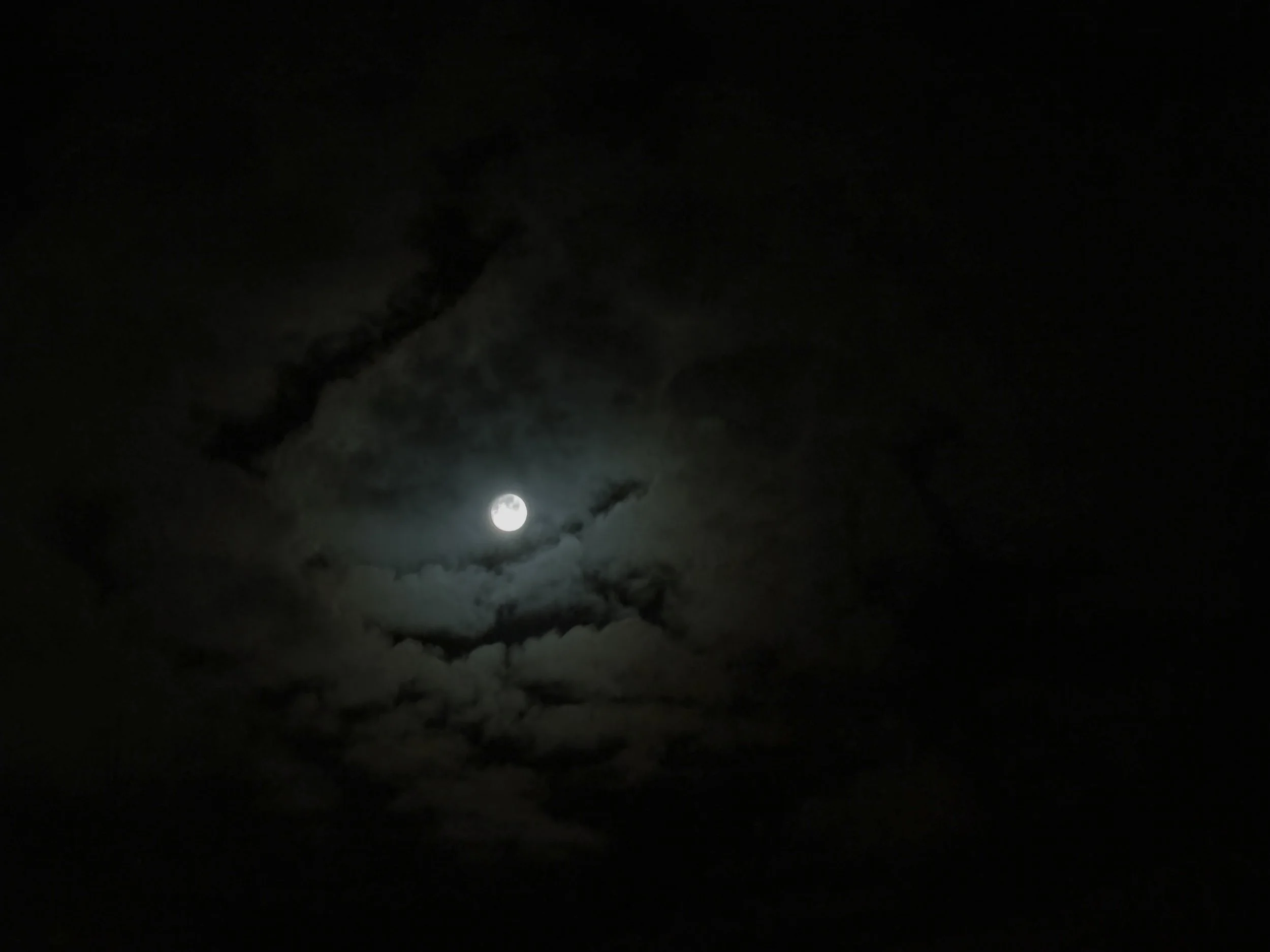
Waxing Gibbous Worm Moon 3/2/2026
I’ve lived a fortunate life. People might say “charmed,” and from their view, they’d be right. Tonight, though, I’m as lost in my thoughts as I’ve ever been. My eyes sink into the inky black waves ahead of me, watching intently as the water rises, falls, and repeats.
Rises, falls
Rises and falls
Rises
Falls
Repeats
This city behind me, in all its light and beauty, requires you to be strong because it is strong. Every hour of every day, steel, brick, and stone — lifted high above the ashes of a great fire — keep itself from sinking back into the swamp it grew out of. When you start to feel the grind of everyday life, it knows, and that’s when it tests you the most.
Charmed?
Entranced?
Cursed?
Today, why not all three?
A small troupe of weak, capricious despots…drench the earth with tides of human gore.
-Edward Rushton, 1793 1
I was eating a Kwik-Trip salad for lunch one day last summer, sitting in the sun, scrolling past various atrocities, when I looked down to notice that my fork was missing a tine.
I stopped chewing, opened my mouth, and gagged. A tide shook my body. My diaphragm convulsed. Half-swallowed spring mix, cherry tomato, and raw onion slid down my chin onto a napkin. I inspected the slop: no tine. I drank a sip of water. I didn’t feel anything sharp in my esophagus. That’s when the anxiety stormed in. I googled “how long will I survive after swallowing sharp sharp shards of plastic”. On an old Reddit post, a self-described nurse, responding to a similar complaint, urged going to the ER without delay. Another respondent on the thread claimed it happened to him once and he suffered no ill effects at all. I sweated through my shirt. Phantom (real?) belly pains stabbed me. I pressed 9-1-1 into my keypad. My thumb hovered over the green “call” button.
The average Gen X adult living in the US today is hosting a silverware set-sized volume of microplastics in their body. And not all from swallowing fork tines. In fact, that may be one of the safer ways to ingest plastics. Micro- and nanoplastics have been found in the carotid artery, the lungs, reproductive organs, and (especially, for some reason) the brain. Once rare, cases of glioblastomas, dementia, and “spontaneous brain bleeding” rose rampantly in the first quarter of the 21st century, but experts insist correlation does not imply causation. We ingest these microplastics when we drink bottled water, when we eat food prepared in non-stick pans; if we live near the coast, we are more susceptible to breathing microplastics as the plastic waste in the sea is churned up by the tide and subsequently sucked into our lungs.

Marine creatures are dying from ingesting our plastic waste. In the oceans, we have generated several islands of plastic. Some of them have names like the Great Pacific Garbage Patch and the Mid-Atlantic Trash Vortex. When the ship I was assigned to was deployed, we would dump all trash and human waste into the ocean. Not plastics though. Plastics were melted down and compressed into big 50-pound discs. Next, these discs were sealed into—you guessed it—plastic bags and “properly”(?) disposed of during the ship’s next port-of-call. An aircraft carrier’s crew generates about six dumpsters worth of trash every day. One of my deployments was nine months long, so yeah, you do the math.
The grey mass in my head has regressed, depressed, pre-pressed like a shrink wrapped Kwik-Trip panini. Microplastics have turned my brain into jelly—or maybe a jellyfish.
Two decades before I swallowed a plastic fork tine, I got stung by a jellyfish. I had just completed final exams in Navy Nuclear Power School in Goose Creek, South Carolina. Five of my classmates and I decided to celebrate the only way that unattached, immature boys of that era knew how. We rented a shack near the beach for a night, copped a stack of DVDs from Blockbuster, and drank copious amounts of booze: a liter of Goldschläger, a handle of Seagram’s Extra Smooth Vodka, a fifth of 99 Bananas, and a case of Smirnoff Ice. After binge drinking to the ‘90s submarine thriller Crimson Tide, we stumbled two blocks to Folly Beach, stripped to our boxers and tussled in the roaring, black Atlantic: laughing, punching, howling to the waxing crescent moon. I snapped photos with my 35mm point-and-shoot, its flash bulb strobing an exclamation point upon the inky black surrounding us, when I felt a lightning bolt of heat radiating up my right calf. The flow tide must have pushed the tentacled beast into the shallows.
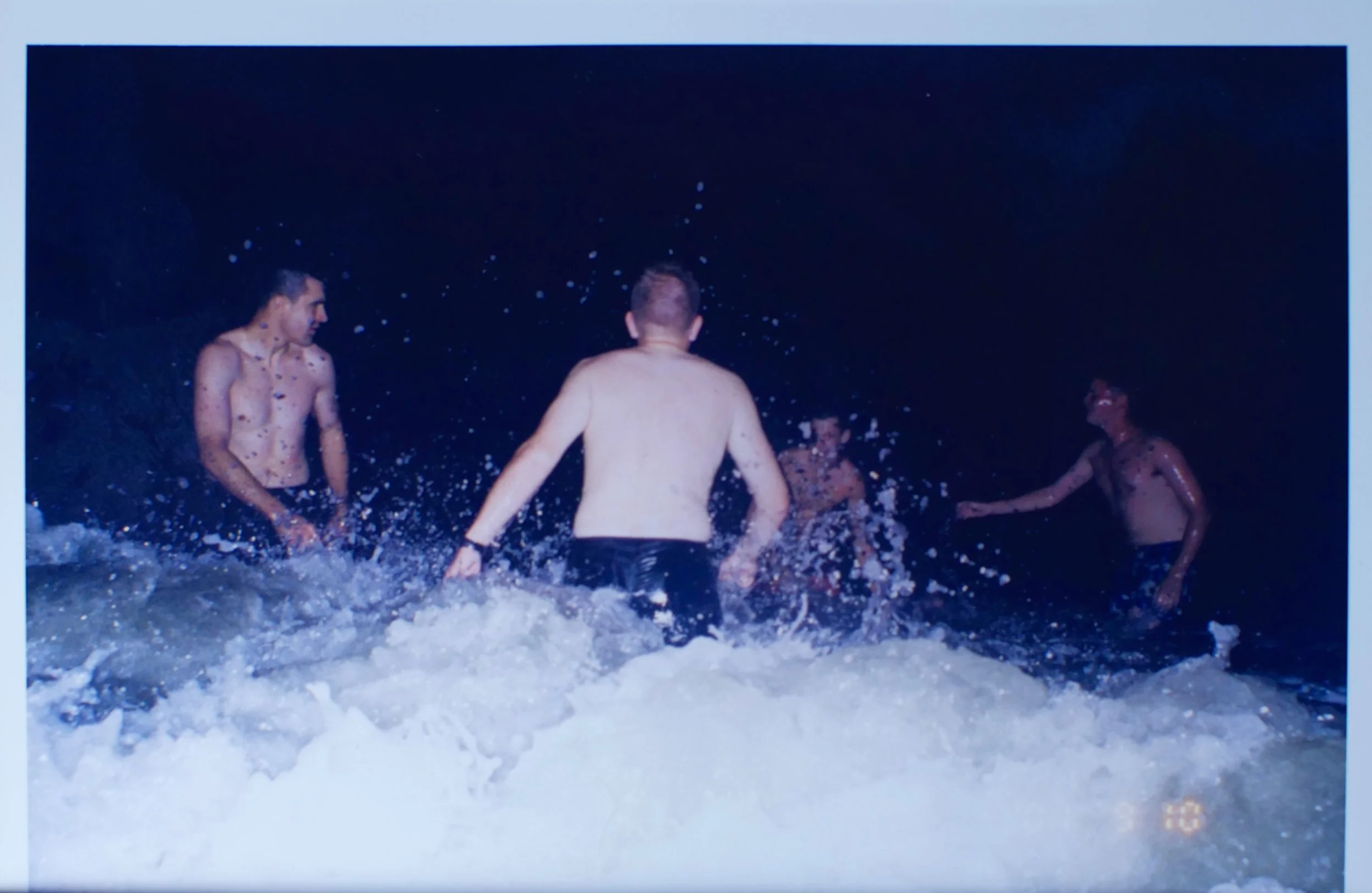
Folly Beach, SC 9/10/2001
The lapping of water against the corrugated metal breakwall brings me back from the memory. By definition, the Great Lakes are non-tidal, though they have a rhythm known as seiches, a sort of oscillation from a center point.
In some of the Great Lakes and other large bodies of water, the time period between the “high” and “low” of a seiche can be as much as four to seven hours. This is very similar to the time period between a high and low tide in the oceans, and is often mistaken as a tide.
I consider briefly what my personal oscillation point is, and whether or not it exists inside me or if my entire life is the whiplash pattern of the wave, my purpose somewhere in the distance. Staring at open water makes a handsome backdrop for an existential crisis. Swimming in open water is for the foolhardy.
I worry about submechanophobia. It’s the fear of submerged manmade objects and somewhat of a niche fear within thalassophobia, a general fear of deep bodies of water. I don’t have either (that I know of) but have been known to spin around in a swimming pool, convinced there is a bull shark behind me. It’s why I prefer swimming in Lake Michigan, where I swim easy knowing there are no sharks, no jellyfish. I hadn’t considered whether fearing the floating bits of plastic trash would classify, even though not technically submerged but very certainly manmade. I suppose that’s plastophobia.
It’s something I think about, anyway.
A few months ago I noticed a ganglion cyst on my right foot. It comes and goes, my own measure of the tides within my body. I considered hitting it with a bible, though that’s no longer recommended. The word ganglion comes from “swelling under the skin,” and the cause is a jelly-like substance accumulating near the joint of a tendon. I had been stung by a jellyfish on my right leg; it’s not impossible there had been a jelly-like transfer.
And maybe the cyst isn’t my oscillation point. With a body full of tides, it’s hard to discern where one ends and one begins which I guess is the point. I don’t think the average person could tell you the exact moment they go from vasoconstriction to vasodilation. But they could probably tell you when their heart starts pounding after sensing a submerged manmade object or phantom bull shark or lost tine of a fork.
In Chicago, the ascent out of the depths of winter is a never-ending series of false peaks. Hope lingers like a puddle at the brink of evaporation, knowing that any next morning you could wake up staring down at a city submerged in snow. Only a fool would believe a few warm rains could fully wash away all this salt.
My cyst flared up overnight; this morning, I quickly learned sneakers would not be a part of my wardrobe today. Tube socks and sea glass-hued HOKA Recovery Slides would have to do. When I bought the slides at REI last Summer, the sales associate helping me out in the store’s shoe area asked:
“Do you incorporate a lot of active recovery into your daily routine?”
“I wish I had more time for it. You think these will do the trick?”
“I really do. These slides are top-notch recovery footwear. Truly, the best you can buy.”
“The best, huh?”
“The best. What’s your sport?”
“Life.”
I’m currently self-employed and work from home. At least once a week, I like to “commute” to different coffee shops throughout the city. It was sunny out today, not a single cloud in the sky. Despite the return of my cyst, the sun was enough to get me out the door.
After a few tours in the Navy, I became obsessed with writing contemporary Jonsonian-style poetry. One of my poems, “Hubris: The Engines of Not War,” went viral on Blogspot. It was then purchased and adapted into a screenplay, which eventually launched an entire cinematic universe. Legally, I’m not able to say which. I’m not receiving a constant flow of money from it, but I also don’t have to think about what I spend on a day-to-day basis. I can pursue my passions freely, and I know I’m fortunate in that way.
I started to believe that if a poem I wrote could be adapted into a screenplay, then I could certainly write a screenplay. Unfortunately, I could not, at least not one that people wanted to buy and turn into a movie. I didn’t give it up, though. For many years, I worked hard at the craft, honing my understanding of human behavior. Online, I researched extensively, profiled characters, and tested plot scenarios. These skills and a few lucky breaks led me to my current line of work: Professional Reddit Detective.
Only a few of us in the CRD (Chicago Reddit Detective) community can truly call ourselves professionals. We’re the unsung heroes of the true crime world. We’re not getting famous on podcasts, spewing fantasy and speculation. We’re going door-to-door in online communities, asking the hard questions and linking together chains of clues like a high-quality fence. We shine our lights on the internet’s darkest subreddits, solve crimes, and occasionally help find out what kind of weird threads a partner is getting into.
When I stepped off the bus near Hexe Coffee Co., a witchy coffee shop at the corner of Diversey and Clybourn, I thought about the waves of chatter I had been hearing online the past few weeks. Something was off, and not just in the digital world. The whole city felt… uncomfortable with itself. Just a few minutes prior, a guy sat down next to me on the bus, fiercely told me he’d seen me in his dreams, got up, and promptly walked right out the door. Then, an older woman sitting three rows behind me began singing the lyrics to The Killers’ song “All These Things That I’ve Done.”
“Another head aches, another heart breaks
I’m so much older than I can take
And my affection, well, it comes and goes
I need direction to perfection, no, no, no, no…”
(Uhhhh, what!?)
I walked up to the counter and ordered a black coffee, an egg-and-cheddar biscuit sandwich, and a chocolate croissant (Already one of those days). While waiting for my breakfast, I sat down with my coffee and opened my laptop.
I didn’t know that what I saw next would alter the course of my day and have me mentally treading water, alone, now starting to shiver, on one of the most spectacular lakefronts in the world. I didn’t know I might never be the same. My day was about to unravel, and so was my mind. At least I had a hot cup of coffee.
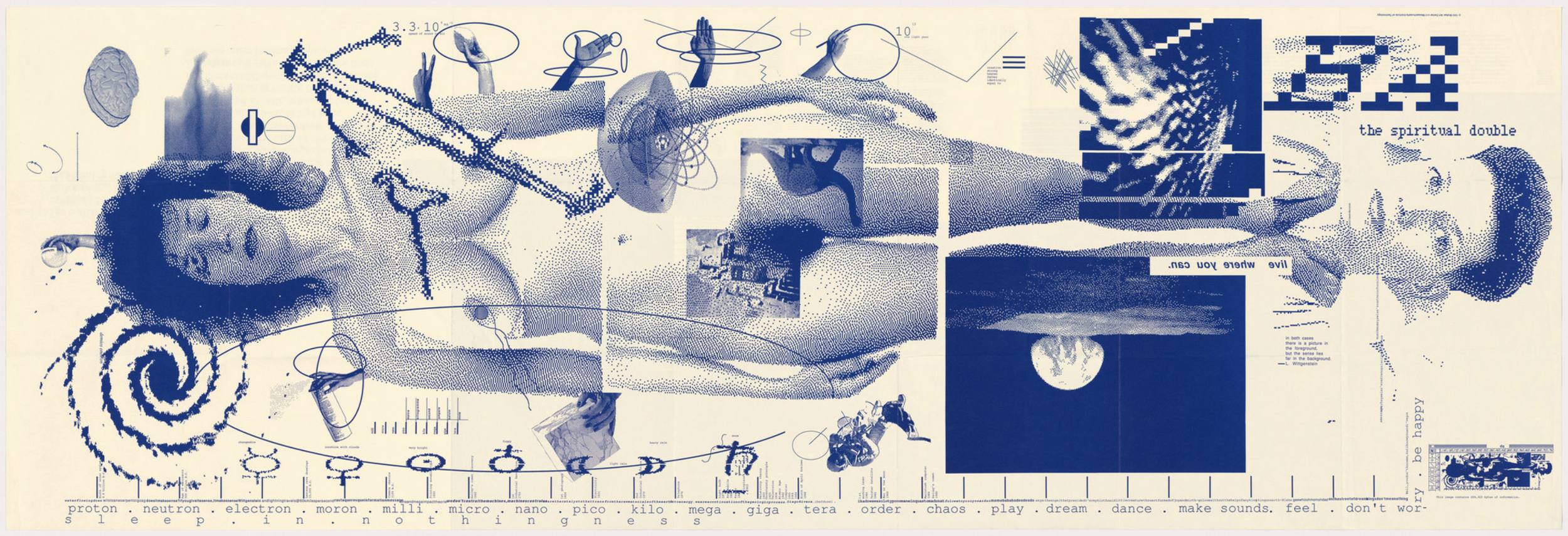
April Greiman “Does It Make Sense?” 1986. Video-computer graphic offset lithograph
I was using a plastic fork to smear artisanal apricot jelly onto my egg and cheddar biscuit, when I noticed it: a new cyst—as big as the moon—had suddenly appeared on my right wrist! I kicked off my HOKA slide and slid my tube sock down to confirm my fear. The ganglion cyst had migrated.
My dermatologist/spiritual advisor, Dr. Jean le Rond d’Alembert had once warned me this might happen. “Cysts can—and often do—rise and fall in different areas of the body,” he said. “It’s similar to the way tides rise first in eastern harbors and only later in western ones, following the transit of the moon.”
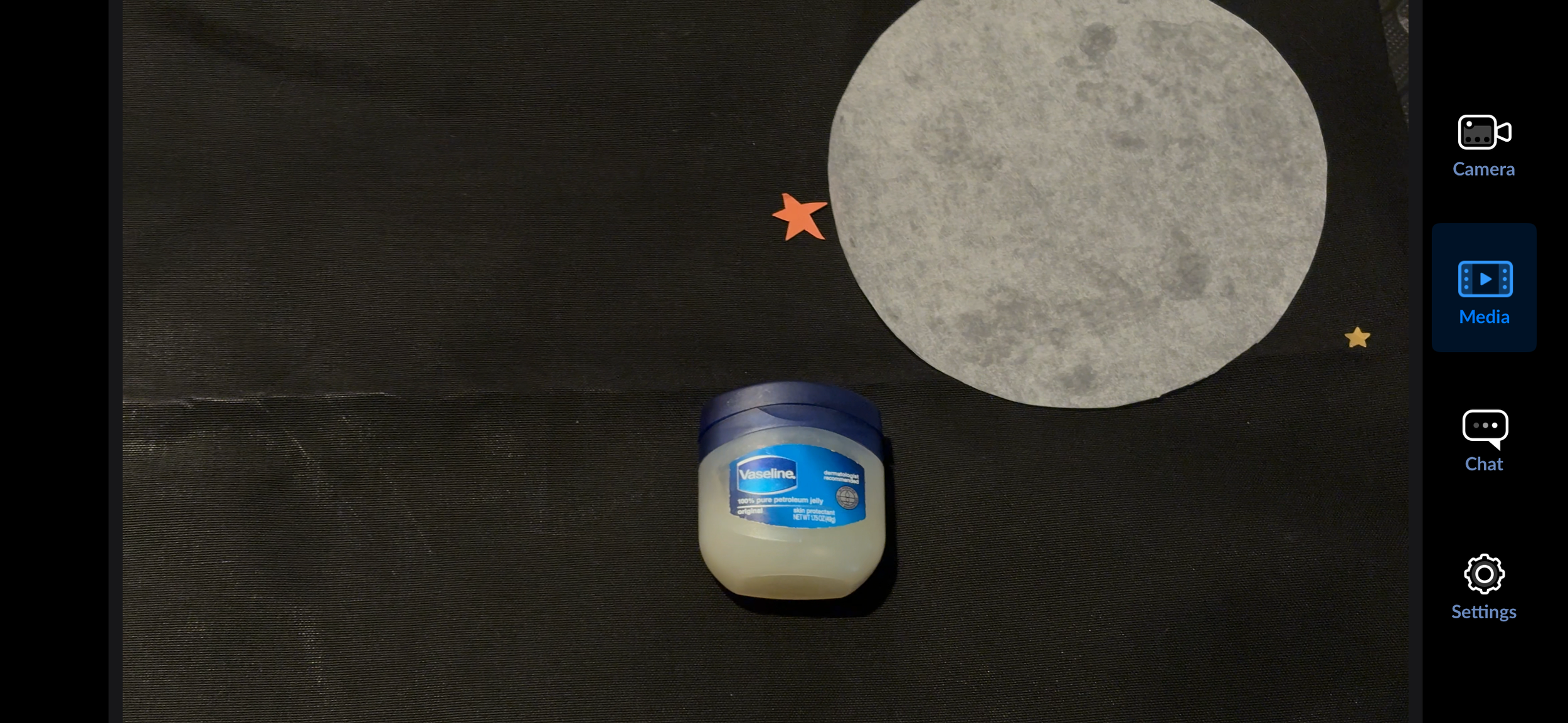
Doctor d’ was a genius. He once developed an equation for certain waves. In mid-February a few years back, while examining me for what I feared was a leprous patch of skin on my inner thigh, he told me that his wave equation “is a linear partial differential” (or something like that) “describing the motion of waves. These could be sound waves, seismic (or body) waves, or even the seiches you may observe on Lake Michigan.” After diagnosing my ‘leprosy’ as little more than dry skin, Doc d’ prescribed Vaseline for my inner thighs and warned me, “Do take care. You must remember the flux et reflux” (what he called tides in his native French) “are always strongest during the worm moon.”

My dermatologist/spiritual advisor Dr. Jean le rond d’Alembert
I scratched raw the ever-growing cyst on my wrist. Doctor d’ was a genius, alright. Not like CRD genius, but pretty smart. I tried to get him to join CRD once, but he declined, claiming he was already booked, co-leading a seminar titled Oscillatory Function in the Baroque Fugue along with his colleague, the composer JP Rameau.
If the highly polished, mathematical fugues of Rameau, Bach, and others represent the flux of classical music, then the chance-based works of mid-20th-century composers like John Cage represent the reflux. Cage’s most famous composition, titled 4’33” instructs the musician(s) to sit silently onstage for four minutes and thirty-three seconds. The resulting “music” is based on chance: the audience shuffling their feet, the clearing of throats, the oscillation of a neighbor’s digestive system. Cage’s compositional style influenced an entire arts movement, called Fluxus.
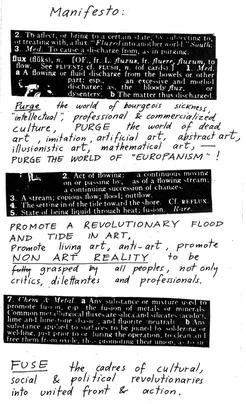
Fluxus Manifesto by George Maciunas, 1963
Fluxus practitioners favored chance and chaos to mathematics and order in the arts. The color-blind Lithuanian artist who penned the Fluxus Manifesto was highly influenced by John Cage and a growing community of artists, poets, and musicians in the early 1960s. In his Fluxus Manifesto, George Maciunas writes that the purpose of Fluxus is: “To promote a revolutionary tide in art…to be grasped by all peoples, not only critics, dilettantes, and professionals.”
Fluxus composer Philip Corner’s piece “Calling! OM” might be exactly what a body tide sounds like. Composed for a performance at the Museum of Modern Art in 1972, “Calling! OM” is scored for a centrally located pianist and two trombonists who are situated in western and eastern rooms, far away from the piano. The trombonists take turns playing long somber notes, oscillating intensity and (dis)harmony as they orbit closer and closer to the piano. The resultant sound rises, falls, crashes, and dissipates. Since trombones don’t have fixed note positions like flutes or trumpets, chance plays a major role in the outcome of each performance.
“Calling! OM” by Philip Corner. Purchase the album here.When I played trombone in elementary school, I used petroleum jelly to keep its slide from sticking.
As I itched my wrist cyst, it exploded onto my plate, oozing a heaping tablespoon of thick, waxy pus and blood. I dabbed at the wound with my napkin. That was when I noticed another cyst rising onto my left wrist!
Bob Chesebrough was a chemist who made a living by rendering sperm whale blubber into lantern fuel in the 1860s. When petroleum was discovered, however, his line of work became obsolete. In desperation, he began lurking around the booming petroleum fields of western Pennsylvania. There, he pocketed globs of the green and gold so-called “rod wax” that steam-driven drill bits left behind.
Bob began marketing his new rod wax derivative in October of 1871. He would post up in town squares across the country, and when a large enough crowd had gathered, Bob would burn himself with fire or acid. He’d then amaze onlookers by applying a smear of his thick apricot-colored jelly to the wound, thereby soothing and healing the site.2 His invention, which he named Vaseline, was a distillation of the petroleum residue, filtered through bone char.
Vaseline became one of the most popular products of the late 19th and early 20th centuries. It was marketed for healing wounds, hemorrhoids, sunburn, cysts, headache, sprains, rheumatism, etc. It could be used as shampoo or pomade, and might “make the Hair grow when nothing else will.” Doctors even prescribed it for internal use. According to marketing materials from 1873, ingesting Vaseline “purifies the blood and cures cough, croup, cold, and sore throat.” Vaseline confectionaries were sold by grocers. In 2015, a German consumer watchdog found that many Vaseline products contain up to 9% mineral oil aromatic hydrocarbons (MOAH), a known carcinogen.
Plastics (and their micro- and nano- derivatives), were another petroleum product invented around the same time as Vaseline. In the 1860s, while looking for a cheaper substitute for ivory billiard balls, John Wesley Hyatt made a fortune when he combined cellulose nitrate with petroleum-derived turpentine and camphor. He called his invention Celluloid. Waxy camphor, which comes from the Camphor tree, is used in religious rituals and has been a substance of abuse for centuries. After snorting a 72 gram dose of powdered camphor, one user said he felt: “a warm tingling in the extremities, a desire to move,” that he saw his “destiny full of great possibilities, clearly before his eyes.” After taking a double dose of the substance, the same narconaut claimed intellectual thought was impossible. “There was a great tide of ideas, each chasing the other with such rapidity that it was impossible to analyze any of them…vomiting helped.”
I wondered if taking Vaseline orally or vomiting might allow me to get rid of this witchy cyst for good. I instinctively pulled out my phone to call the good doc, but then remembered I could no longer do so. That worm moon was the last time I saw Dr. d’Alembert. He died from a cyst on his bladder and—being a known nonbeliever—he was buried in an unmarked grave. For all I know, he was interred in the potter’s field under Chicago’s lakefront Lincoln Park, where in October 1871, the Great Fire reached its flux maximum.
I burst through the surface, an all-consuming gasp for air as I press STOP on my watch.
3:03. A slight improvement from my previous hold of three minutes. The colder the water, the more challenging it is to hold your breath. While cold water is physically numbing, racing, even unhinged thoughts are normal. It’s the body’s fight or flight response—your brain is keeping your body alive.
My head settles. I swim over to the ladder and carefully climb onto the concrete shoreline. My towel around my waist, I pull my winter coat on, shoving my bare feet back into my tube socks. A lot of people ask me why and how I do it. And I tell them I don’t know but it’s the only thing I’ve found to keep me from sinking all the way to the bottom.
Of the depths of my mind, not the lake, that is.
I light a cigarette and take a long drag. A sardonic reward for my efforts.
I look out as the moon’s reflection dances on the lake.
And if only briefly,
rhythm is restored.
Thank you for reading Body Tides! This project arose out of a desire to collaborate with two of my favorite people on the planet, Alysha Daytner and Tommy Free Jazz on the CTA Crawford. Huge thanks to both of them for their patience and for putting up with my zesty narrative oscillations!These two introduced a moment of brightness and levity into a dark and heavy month: I think it was Alysha who first uttered the phrase “body tides.” I thought I heard “body tithes,” but neither phrase made a bit of sense to my gelatinous brain. The three of us laughed and traded possible definitions. Tommy suggested “body tides” as our first Substack collaboration, and with that, this post was born.It was a joy to create this piece with those friends over the past month. Please subscribe to their publications! You won’t be disappointed.Love, Uncle JRushton was a blind British poet who had—in his youth—worked onboard a slave ship, but subsequently became an abolitionist
He eventually was forced to cease using this technique; his multiple wounds gave him the appearance of a leper, and so his potential audiences dwindled
